Single-Supply Instrumentation Amplifier

The OP284 is a low noise dual op amp with a bandwidth of 4MHz and rail-to-rail input/output operation. These properties make it ideal for low supply voltage applications such as in a two op amp instrumentation amplifier as shown in the diagram. The circuit uses the classic two op amp instrumentation topology with four resistors to set the gain. The transfer equation of the circuit is identical to that of a non-inverting amplifier. Resistors R2 and R3 should be closely matched to each other as well as to resistors (R1+P1) and R4 to ensure good common-mode rejection (CMR) performance. It is advisable to use resistor networks for R2 an and R3, because these exhibit the necessary relative tolerance matching for good performance.


Potentiometer P1 is used for optimum d.c. CMR adjustment, and capacitor C1 is used to optimize a.c. CMR. With circuit values as shown, circuit CMR is better than 80 dB over the frequency range of 20 Hz to 20 kHz. Circuit referred-to-input (RTI) noise in the 0.1 Hz to 10 Hz band is exemplary at 0.45 µVpp. Resistors R5 and R6 protect the inputs of the op amps against over-voltages. Capacitor C2 may be included to limit the bandwidth. Its value should be adjusted depending on the required closed-loop bandwidth of the circuit. The R4-C2 time constant creates a pole at a frequency, f3dB, equal to f3dB=1/2πR4C2. With a value of C2 of 12 pF, the bandwidth is about 500 kHz. The amplifier draws a current of about 2mA. 

LM338 Power Supply +13.8V 5A

This ac to dc power supply can output 5A in continous operation and 12A peak current. This kind of dc power supplies uses a PCB so you can use two case types for IC1, TO-220 or TO-3. The regulation of this 12 volt power supply is made with TR1 ( multiturn ). IC1 must be placed on proper heatsink.

LM338 Power Supply Circuit Diagram :

LM338 Power Supply Circuit Diagram


Transformerless Power Supply

This circuit will supply up to about 20ma at 12 volts. It uses capacitive reactance instead of resistance; and it doesn't generate very much heat.The circuit draws about 30ma AC. Always use a fuse and/or a fusible resistor to be on the safe side. The values given are only a guide. There should be more than enough power available for timers, light operated switches, temperature controllers etc, provided that you use an optical isolator as your circuit's output device. (E.g. MOC 3010/3020) If a relay is unavoidable, use one with a mains voltage coil and switch the coil using the optical isolator.C1 should be of the 'suppressor type'; made to be connected directly across the incoming Mains Supply.

They are generally covered with the logos of several different Safety Standards Authorities. If you need more current, use a larger value capacitor; or put two in parallel; but be careful of what you are doing to the Watts. The low voltage 'AC' is supplied by ZD1 and ZD2. The bridge rectifier can be any of the small 'Round', 'In-line', or 'DIL' types; or you could use four separate diodes. If you want to, you can replace R2 and ZD3 with a 78 Series regulator. The full sized ones will work; but if space is tight, there are some small 100ma versions available in TO 92 type cases. They look like a BC 547. It is also worth noting that many small circuits will work with an unregulated supply.

Transformerless Power Supply Circuit Diagram:

Power Supply Circuit Diagram

You can, of course, alter any or all of the Zenner diodes in order to produce a different output voltage. As for the mains voltage, the suggestion regarding the 110v version is just that, a suggestion. I haven't built it, so be prepared to experiment a little. I get a lot of emails asking if this power supply can be modified to provide currents of anything up to 50 amps. It cannot. The circuit was designed to provide a cheap compact power supply for Cmos logic circuits that require only a few milliamps. The logic circuits were then used to control mains equipment (fans, lights, heaters etc.) through an optically isolated triac.

If more than 20mA is required it is possible to increase C1 to 0.68uF or 1uF and thus obtain a current of up to about 40mA. But 'suppressor type' capacitors are relatively big and more expensive than regular capacitors; and increasing the current means that higher wattage resistors and zener diodes are required. If you try to produce more than about 40mA the circuit will no longer be cheap and compact, and it simply makes more sense to use a transformer. The Transformerless Power Supply Support Material provides a complete circuit description including all the calculations.

Web-masters Note:
I have had several requests for a power supply project without using a power supply. This can save the expense of buying a transformer, but presents potentially lethal voltages at the output terminals. Under no circumstances should a beginner attempt to build such a project.

Important Notice:
Electric Shock Hazard. In the UK,the neutral wire is connected to earth at the power station. If you touch the "Live" wire, then depending on how well earthed you are, you form a conductive path between Live and Neutral. DO NOT TOUCH the output of this power supply. Whilst the output of this circuit sits innocently at 12V with respect to (wrt) the other terminal, it is also 12V above earth potential. Should a component fail then either terminal will become a potential shock hazard.

MAINS ELECTRICITY IS VERY DANGEROUS.
If you are not experienced in dealing with it, then leave this project alone. Although Mains equipment can itself consume a lot of current, the circuits we build to control it, usually only require a few milliamps. Yet the low voltage power supply is frequently the largest part of the construction and a sizeable portion of the cost.

0-30 Volt Laboratory Power Supply

The linear power supply, shown in the schematic, provides 0-30 volts, at 1 amp, maximum, using a discrete transistor regulator with op-amp feedback to control the output voltage. The supply was constructed in 1975 and has a constant current mode that is used to recharge batteries.

With reference to the schematic, lamp, LP2, is a power-on indicator. The other lamp (lower) lights when the unit reaches its preset current limit. R5, C2, and Q10 (TO-3 case) operate as a capacitor multiplier. The 36 volt zener across C2 limits the maximum supply voltage to the op-amps supply pins. D5, C4, C5, R15, and R16 provide a small amount of negative supply for the op-amps so that the op-amps can operate down to zero volts at the output pins (pins 6). A more modern design might eliminate these 4 components and use a CMOS rail-to-rail op-amp. Current limit is set by R3, D1, R4, R6, Q12, R10, and R13 providing a bias to U2 that partially turns off transistors Q9 and Q11 when the current limit is reached. R4 is a front panel potentiometer that sets the current limit, R22 is a front panel potentiometer that sets the output voltage (0-30 volts), and R11 is an internal trim-pot for calibration. The meter is a 1 milliamp meter with an internal resistance of 40 ohms. Switch S1 determines whether the meter reads 0-30 volts, or 0-1 amp. 

0-30 Volt Laboratory Power Supply Circuit Diagram:

0-30 Volt Laboratory Power Supply Circuit Diagram

A more modern circuit might use a single IC regulator, such as the MC78XX, or MC79XX series, immediately after the half wave rectifier, to replace approximately 30 components, or at least a high precision zener diode to replace D10 as the voltage reference. The LM4040 is one such voltage reference and has excellent stability over temperature. IC regulators such as the MC78XX series may eventually become obsolete as newer IC regulators are designed, however, discrete transistors, op-amps, and zeners are more generic, have a longer production lifespan, and allow the designer to demonstrate that he understands the principles of linear regulated power supply operation.

Light and Sound Indicator for Mains Power Supply Project

While repairing or installing electrical machines in a building, the AC mains power supply is switched off from the mains electrical switchboard installed outside the building. There is a chance that someone who is not aware of the same may switch on the mains from outside. This poses a great danger for the technician working inside. Hence, an indicator like the one described here, which can be plugged into a nearby mains wall socket, might prove very useful for the technician.


This circuit can also be useful for people who are living in a place where there is frequent mains power cut.

Circuit and working
The circuit diagram of the light and sound indicator for the mains power supply is shown Fig. 1. The circuit is built around capacitors C1 and C2, resistors R1 and R2, diode D1, zener diode ZD1, LED1 and a piezo buzzer (PZ1). Resistor R1 and capacitor C1 are used for reducing the voltage and limiting the current. Diode D1 is a rectifier.

C2 is used as a filtering capacitor. Zener diode ZD1 limits the output voltage to around 12V. The value of zener diode should be equal to or lower than the maximum voltage of the buzzer and higher than the minimum voltage. Preferably, the buzzer should have a built-in oscillator working in the range of 6V-12V and requiring a current below 10mA. The frequency of the alarm sound is usually in several kilohertz (kHz).

LED1 is on when the mains power supply is present, and at the same time the buzzer produces sound. Resistor R1, capacitor C1 and diode D1 are selected depending on the current requirement of the buzzer.

Circuit diagram of the mains power indicator
Fig. 1: Circuit diagram of the mains power indicator


Fig. 2: Actual-size, single-side PCB of the indicator


Fig. 3: Component layout of the indicator


Construction and testing
An actual-size, single-side PCB of the simple light and sound indicator is shown in Fig. 2 and its component layout in Fig. 3. Enclose the PCB in a suitable small box in such a way that you can use it during repair work or installation. Ensure proper wiring to avoid any mistake.

Sourced by: EFY

Petre Tzv Petrov was a researcher and assistant professor in Technical University of Sofia, Bulgaria, and expert-lecturer in OFPPT, Casablanca, Kingdom of Morocco. He is currently working as an electronics engineer in the private sector in Bulgaria

Simple 12V Portable and Mobile Power Supply Schematic

This is the Simple 12V Portable and Mobile Power Supply Schematic .This type of power supply can be built quite inexpensively and needs only a minimum of circuitry. This circuit will give output current of 1 amp, well stabilized and smoothed.


Simple 12V Portable and Mobile Power Supply Schematic


Simple 12V Portable and Mobile Power Supply Schematic


The smoothing and regulation is provided by IC1 7812 which is a 12V monolithic voltage regulator. Thisportable power supplyunit incorporates output current limiting and is therefore not damaged by accidental short term short circuits or other forms of output overloading.
 
components Resistor1/3 watt 5%
R1 1.8k
Capacitors
Cl 2200uF 25V electrolytic
C2 100nF polyester (C280)
C3 100nF polyester (C280)
Semiconductors
ICI uA78I2 (12 volt 1 amp positive regulator)
D1 to D4 1N4002(4 off)
Switch
S1 DPST toggle type
Transformer
T1 Standard mains primary, 15 — 0 — 15 volt 2 amp secondary

Single-cell Power Supply Circuit Diagram

Many modern electronic devices and micro-controller based circuits need a 5 V or 3.3 V power  supply. It is important  that  these voltages are constant and so a regulator of some kind is essential, including in battery powered devices. The simplest approach is to select a (perhaps rechargeable) battery whose voltage is rather higher than that required by the circuit and use an ordinary  linear voltage regulator. Unfortunately this solution is rather wasteful of precious energy and space: for a 5 V circuit at least six NiCd or NiMH cells would be required.

Both these disadvantages can be tackled using a little modern electronics. A good way to minimise energy losses is to use a switching regulator, and if we use a regulator with a step-up topology then we can simultaneously reduce the number of cells needed to power the circuit. Fortunately it is not too difficult to design a step-up converter suitable for use in portable equipment as the semi-conductor manufacturers make a wide range of devices aimed at exactly this kind of application. The Maxim MAX1708 is one example. It is capable of accepting an input voltage anywhere in the range from 0.7 V to 5 V, and with the help of just five external capacitors, one resistor, a diode and a coil, can generate a fixed output voltage of 3.3 V or 5 V. With two extra resistors the output voltage can be set to any desired value between 2.5 V  and 5.5 V. 

Circuit diagram :


Characteristics
  • Input voltage from 0.7 V to 5 V
  • Output voltage from 2.5 V to 5.5
  • Maximum output current 2 A
  • Can run from a single cell
The technical details of this integrated circuit can be  found on the manufacturer’s website [1], and the full datasheet is available for download. An important feature of  the device is that it includes an internal reference and integrated power switching MOSFET, capable of handling currents of up to 5 A. It is, for example, possible to convert 2 V at  5 A at the input to the circuit into 5 V at 2 A at the output, making it feasible to build a 5 V regulated supply powered from just two NiCd  or NiMH cells. With a single cell the maximum possible current at 5 V would  be reduced to around 1 A.

The example circuit shown here is configured for an output voltage of 5 V. The capacitor connected to pin 7 of the IC  enables the ‘soft start’ feature. R2 provides current limiting  at slightly more than 1 A. For maximum output current R2  can be dispensed with. Pins 1 and 2 are control inputs that allow the device to be shut down. To configure the device  for 3.3 V output, simply connect pin 15 to ground.
The coil and diode need to be selected carefully, and depend on the required current output. To minimise  losses D1 must be a Schottky type: for a 1A output current the SB140 is a suitable choice.

For L1 a fixed power inductor, for example from the Fastron PISR series, is needed. A fundamental limitation of the step-up converter is that the input voltage must be lower than the output voltage. For example, it is not possible to use a  3.7 V  lithium-polymer cell (with a terminal voltage of 4.1 V fully charged) at the input and expect to be able to generate a 3.3 V output, as diode D1 would  be  permanently conducting. On the other hand, there is no difficulty in generating a 5 V  output from a lithium-polymer cell.

Micropower Voltage Regulator Circuit Diagram

This circuit was developed to power an AVR microcontroller from a 12 V lead-acid battery. The regulator itself draws only 14 µA. Of course, there are dedicated ICs, for example from Linear Technology or Maxim, which can be used, but these can be very hard to get hold of and are frequently only available in SMD packages these days. These difficulties are simply and quickly avoided using this discrete circuit.

Circuit diagram :


The series regulator component is the widely-available type BS170 FET. When power is applied it is driven on via R1. When the output voltage reaches 5.1 V, T2 starts to conduct and limits any further rise in the output voltage by pulling down the voltage on the gate of T1. The output voltage can be calculated as follows:

UOUT = (ULED + UBE) × (R4 + R2) / R4

where we can set ULED at 1.6 V and UBE at 0.5 V. The temperature coefficients of ULED and UBE can also be incorporated into the formula. The circuit is so simple that of course someone has thought of it before. The author’s efforts have turned up an example in a collection of reference circuits dating from 1967: the example is very similar to this circuit, although it used germanium transistors and of course there was no FET. The voltage reference was a Zener diode, and the circuit was designed for currents of up to 10 A. Perhaps our readers will be able to find even earlier examples of two-transistor regulators using this principle?


Power Supply with High Voltage Isolation

Occasionally you come across some unusual  situations when setting up measurement  systems. The author once had to set up a system to register the vibrations and strain supposed to be  present in a contactor that operated at a voltage of 25 kVAC.

One of the biggest problems with this project turned out to be the power supply for  the measurement system. Since it required  a power of about 30 W it wasn’t possible to  use batteries since the system had to operate  for many hours at a time. A logical solution  would seem to be to use an isolating trans-former, but still.25 kVAC means a peak volt-age approaching 40 kV, and on top of that  you would have to include a safety margin. In  addition, everything that is connected to high  voltage lines should also be able to withstand  lighting strikes!

Circuit diagram :
Power Supply


Power Supply with High Voltage Isolation Circuit Diagram

Consequently the isolation should be able to  cope with a test voltage of 150 kV, which is a  lot to ask of the isolating material.

After extensive research no supplier could be  found for a transformer rated at 50 W, 230 V  primary, 12 V secondary and an isolation of  25 kVAC. Because of this, a dynamic system  had to be used that unfortunately suffers a  bit from wear and tear. This system consists  of a 50 W 3-phase motor connected up via an  isolating drive-shaft to a 30 W generator (a  3-phase servo motor that was used as a generator), which provides the power for the data  logger and associated electronics.

Because a 3-phase generator was used, the  voltage obtained after full-wave rectification (via D1 and D4 to D8) already looked good,  also because the revs of the generator was  fairly high. The secondary supply can there-fore remain fairly simple. The main supply of 9 VDC is stabilised by IC3, an LM317T. From  there it is fed to a few small DC/DC modules  (IC1, IC4, IC5), which supply voltages of +5 V,  +30 V and -9 V, which are required by the other parts of the circuit. IC2 (LM566, a volt-age controlled oscillator) makes LED D2 flash  when the supply voltage is present.

Stable USB Power Supply Circuit Diagram

A common problem when an AC mains adapter is used to power a USB device is that the voltage does not match the nominal 5 V specified by the USB standard. The circuit shown here accepts an input voltage in the range of 4-9 V and converts it into a 6-V output voltage, which is then stabilized to a clean 5-V level by a series regulator. The combined boost/buck converter used here operates on the SEPIC principle. That principle is quite similar to the operating principle of the Cuk converter, but without the disadvantage of a negative output voltage.

Circuit diagram :

Stable-USB-Power-Supply-Circuit-Diagram
Stable USB Power Supply Circuit Diagram

The circuit is built around a MAX668, which is intended to be used as a controller for boost converters. The difference between a SEPIC converter and a standard boost (step-up) converter is that the former type has an additional capacitor (in this case C2) and a second inductor (in this case, the secondary winding of transformer L1). If C2 is replaced by a wire bridge and the secondary winding of L1 is left open, the result is a normal boost converter. In that case, a current can always flow from the input to the output via L1 and D1, even when the FET is not driven by IC1. Under these conditions, the output voltage can never be less than the input voltage less the voltage drop across the diode.

The operation of a SEPIC converter can be explained in simple terms by saying that C2 prevents any DC voltage on the input from appearing at the output, so the output voltage can easily be made lower than the input voltage. The second coil causes a defined voltage to be present at the anode of D1. It is also possible to replace the transformer by two separate coils that are not magnetically coupled. However, the efficiency of the circuit is somewhat higher if coupled coils are used as shown here. The value of resistor R4 is chosen to limit the maximum current to 500mA, which is also the maximum current that a USB bus can provide according to the specifications. Resistors R1 and R2 cause the voltage across C3 and C7 to be regulated at a value of around 6 V. A low-drop regulator (LM2940) is used to generate a stabilized 5V from the 6V output (with ripple voltage). The efficiency should be somewhere between 60% and 80%

Supply Voltage Monitor Circuit Diagram

Supply Voltage Monitor Circuit Diagram. A circuit for monitoring supply voltages of ±5 V and ±12 V is readily constructed as shown in the diagram. It is appreciably simpler than the usual monitors that use comparators, and AND gates. The circuit is not intended to indicate the level of the inputs. In normal operation, transistors T1 and T3 must be seen as current sources. The drop across resistors R1 and R2 is 6.3 V (12 –5 –0.7). This means that the current is 6.3mA and this flows through diode D1 when all four voltages are present. However, if for instance, the –5 V line fails, transistor T3 remains on but the base-emitter junction of T2 is no longer biased, so that this transistor is cut off. When this happens, there is no current through D which then goes out.

Supply Voltage Monitor Circuit Diagram


Simple UPS Power Supply Circuit Diagram

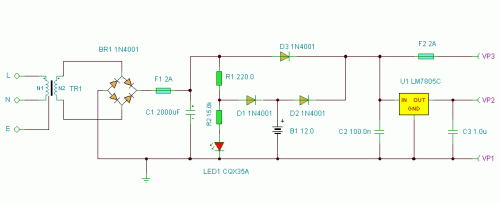
This is the Simple UPS Power Supply Circuit Diagram. This circuit is a simple form of the commercial UPS, the circuit provides a constant regulated 5 Volt output and an unregulated 12 Volt supply. In the event of electrical supply line failure the battery takes over, with no spikes on the regulated supply.

Notes:

This circuit can be adapted for other regulated and unregulated voltages by using different regulators and batteries. For a 15 Volt regulated supply use two 12 Volt batteries in series and a 7815 regulator. There is a lot of flexibility in this circuit.

TR1 has a primary matched to the local electrical supply which is 240 Volts in the UK. The secondary winding should be rated at least 12 Volts at 2 amp, but can be higher, for example 15 Volts. FS1 is a slow blow type and protects against short circuits on the output, or indeed a faulty cell in a rechargeable battery. LED 1 will light ONLY when the electricity supply is present, with a power failure the LED will go out and output voltage is maintained by the battery. The circuit below simulates a working circuit with mains power applied:

Simple UPS Power Supply Circuit Diagram


Between terminals VP1 and VP3 the nominal unregulated supply is available and a 5 Volt regulated supply between VP1 and VP2. Resistor R1 and D1 are the charging path for battery B1. D1 and D3 prevent LED1 being illuminated under power fail conditions. The battery is designed to be trickle charged, charging current defined as :- (VP5 - 0.6 ) / R1 where VP5 is the unregulated DC power supply voltage.

Simple UPS Power Supply Circuit Diagram

D2 must be included in the circuit, without D2 the battery would charge from the full supply voltage without current limit, which would cause damage and overheating of some rechargeable batteries. An electrical power outage is simulated below:

Simple UPS Power Supply Circuit Diagram


Note that in all cases the 5 Volt regulated supply is maintained constantly, whilst the unregulated supply will vary a few volts.

Standby Capacity

The ability to maintain the regulated supply with no electrical supply depends on the load taken from the UPS and also the Ampere hour capacity of the battery. If you were using a 7A/h 12 Volt battery and load from the 5 Volt regulator was 0.5 Amp (and no load from the unregulated supply) then the regulated supply would be maintained for around 14 hours. Greater A/h capacity batteries would provide a longer standby time, and vice versa.
Author: Andy Collinson

Electronic Fuse for DC Short Circuit Protection

This is an electronic fuse that protects the load against short circuit.

Project Description

Relays must be chosen with a voltage value equals to the input voltage. Don’t omit using the 100uF capacitor with appropriate voltage value with respect to the input voltage. If you can’t provide, you can use C106 instead of BRX46.

Circuit Project: Electronic Fuse for DC Short Circuit Protection by BRX46


You can adjust the current with using 10K potentiometer. If you will use the fuse with very high currents, lower the 0R6 5W resistor value (ex. 0R47, 0R33, 0R22 or 0R1). Watt value of the resistor should be increased also.

Universal DC Power Supply Circuit Diagram

I didn't realize till the other day that I have never shown a circuit for a standard power supply. Shown below is a supply that will use any of the LM78XX series of voltage regulators. The transformer in the circuit will vary depending on which regulator you use. For voltages from 5 to 12 use a transformer with output of 18vac. With voltages from 15 to 24 use a transformer of 30vac. The first capacitor in the circuit may need to vary if you are supplying more current to the load. Typically it will be 2000uf for every amp of current.

Universal DC Power Supply Circuit Diagram


Adjustable Symmetrical Power Supply Using LM317 and LM337

The circuit was designed to provide an adjustment with a power supply that is symmetrically designed while providing a voltage range of 1.25V to 30V at 1A current. LM317 – an adjustable 3-terminal positive voltage regulator capable of supplying in excess of 1.5A over an output voltage range of 1.2V to 37V and requires only two external resistors to set the output voltage due to its internal current limiting, thermal shutdown and safe area compensation, making it essentially blow-out proof LM337 – an adjustable 3-terminal positive voltage regulator capable of supplying in excess of 5A used as battery chargers, constant current regulators, and adjustable power supplies due to its features such as protected output from short circuit, product enhancement tested, current limit constant with temperature, guaranteed thermal regulation, adjustable output down to 1.2V, guaranteed 5A, and guaranteed 7A peak output current.

Adjustable Symmetrical Power Supply Using LM317 and LM337

The circuit will serve as a voltage converter with an input voltage of 35 V to produce an output voltage of 1.25 V to 30 V. The positive voltage is being handled by LM317 IC while the negative voltage is handled by LM337. The circuit can provide an output current of 1 A. During the production of 1 A current, the regulator is dissipating too much heat and without the presence of a heatsink, the regulator may get damaged.

Using these types of regulators provide features such as low noise and low price in the market. It can be made operational even with few components used. The only disadvantage that it will impose is the poor conversion efficiency. With the output of 35 V to 5 V, the efficient ratio of the output power with the input power is less than 42%. This is the reason why the switching regulator became cheap recently although the number of external components to be connected is minimally increased. These regulators will work with better efficiency when used in case where current is more than 1A for more than 15 V and 0.4 A for less than 15 V from the power supply. Each regulator is adjusted for single positive and negative voltage output using the 10K ohms potentiometers RV1 & RV2. For dual outputs, a dual connected potentiometer RV3 is made to operate by switch S1. The visual indication on the voltmeter V1 is shown using the switch S2.
  • R1-2=270ohms
  • R3-4=2.2Kohms
  • R5-6=10Kohms
  • C1-5=100uF/63V
  • C2-4=100nF/100V
  • C3-8=10uF/25V
  • C6-10=100uF/63V
  • C7-9=100nF/100V
  • RV1-2=10Kohms Lin.
  • RV3=2X10Kohms Lin.
  • IC 1=LM 317T
  • IC 2=LM 337T
  • D1-2=1N4001
  • D3-4=1N4001
  • L1-2=LED 3mm
  • F1-2=1A slow Blow Fuse
  • S1-2=2X ON-ON SW
  • V1=0-30V DC Voltmeter
The adjustable symmetrical power supply is suitable to be used in audio amplifiers, microphone amplifiers, op-amp applications, impedance converters and other devices that require regulated positive and negative DC supply, since the output current is 1 A.

LM317 Circuit With 12v Battery Charger Circuit Diagram


The LM317 is AN adjustable three terminal transformer that is capable of supply 1.2 to 37 volts with a secure 1.5A output current. The LM317 is prepackaged terribly} normal electronic transistor package that makes it very simple to mount in your circuits. 
Schematic


Overview
The LM317 series of adjustable 3-terminal positive voltage regulators is capable of supply in more than 1.5A over a 1.2V to 37V output vary. they're exceptionally simple to use and need solely 2 external resistors to line the output voltage. Further, each line and cargo regulation square measure higher than normal mounted regulators.

In addition to higher performance than mounted regulators, the LM317 series offers full overload protection out there solely in IC's. enclosed on the chip square measure current limit, thermal overload protection and safe space protection.

The LM317 makes AN particularly easy adjustable change regulator, a programmable output regulator, or by connecting a set electrical device between the adjustment pin and output, the LM317 may be used as a preciseness current regulator. provides with electronic conclusion may be achieved by clamping the adjustment terminal to ground that programs the output to one.2V wherever most masses draw very little current.

Pinout

Options


Specifications

  • Guaranteed 1% output voltage tolerance (LM317A)
  • Guaranteed max. 0.01%/V line regulation (LM317A)
  • Guaranteed max. 0.3% load regulation (LM117)
  • Guaranteed 1.5A output current
  • Adjustable output down to 1.2V
  • Current limit constant with temperature
  • P + Product Enhancement tested
  • 80 dB ripple rejection
  • Output is short-circuit protected
Output Formula

Circuit
Once you have learnt enough you can now put the LM317 into use and make the following circuit:
  
12v Battery Charger Circuit
The circuit may be accustomed charge 12V lead acid batteries.

Overview

Pin one of the LM317 IC is that the management pin that is employed to manage the charging voltage, Pin a pair of is that the output at that the charging voltage seems, Pin three is that the input to that the regulated DC offer is given.

The charging voltage and current is controlled by the electronic transistor (Q1), electrical device (R1) and POT (VR1). once the battery is 1st connected to the charging terminals, the present through R1 will increase. This successively will increase the present and voltage from LM317. once the battery is totally charged the charger reduces the charging current and also the battery are charged within the trickle charging mode.

Circuit


Notes
  • The input voltage to the circuit should be a minimum of 3V more than the expected output voltage. luminous flux unit 317 dissipates around 3V throughout its operation. Here I used 18V DC because the input.
  • The charging voltage may be set by victimization the POT (VR1).
  • The luminous flux unit 317 should be mounted on a sink.
  • All capacitors should be rated a minimum of 25V.
  • You'll be able to use crocodilian clips for connecting the battery to the charger.

230 V AC To 400 V DC Power Supply Circuit Diagram


Description

               A lot of students are who don't know how to convert 230 volt AC to 400 DC. So today i am published  ' 230 V AC to 400 V DC circuit diagram ' on my blog. Working principle of this circuit diagram is very simple. You already knew the working principle of a bridge rectifier. This circuit is same as bridge rectifier and the working principle is also same. The fuse is used to protect the circuit, if the current is greater than 1 A.


Parts List

Component No:Value
F11 A
B1IN4007 
C1470MF/450V 
V1230 V AC 

1.5 - 35 Volt DC Regulated Power Supply Circuit Project

Here is the circuit diagram of regulated power supply. It is a small power supply that provides a regulated voltage, adjustable between 1.5 and 35 volts at 1 ampere. This circuit is ready to use, you just need to add a suitable transformer. This circuit is thermal overload protected because the current limiter and thermal overload protection are included in the IC.

Picture of the circuit:
 1A 1.5 volt to 35 volt dc Regulated Power Supply Circuit Schematic
1A Regulated Power Supply Circuit Schematic
Circuit diagram:
 1A 1.5 volt to 35 volt dc Regulated Power Supply Circuit Diagram
1A Regulated Power Supply Circuit Diagram
Transformer selection chart:
  Transformer Selection Chart for 1A 1.5 volt to 35 volt dc Regulated Power Supply Circuit Diagram
Transformer selection Guide-Table For Power Supply
Parts:
IC = LM317
P1 = 4.7K
R1 = 120R
C1 = 100nF - 63V
C2 = 1uF - 35V
C3 = 10uF - 35V
C4 = 2200uF - 35V
D1-D4 = 1N4007

Features:
  • Just add a suitable transformer (see table)
  • Great to power your projects and save money on batteries
  • Suitable as an adjustable power supply for experiments
  • Control DC motors, low voltage light bulbs, …
Specifications :
  • Preset any voltage between 1.5 and 35V
  • Very low ripple (80dB rejection)
  • Short-circuit, thermal and overload protection
  • Max input voltage : 28VAC or 40VDC
  • Max dissipation : 15W (with heatsink)
  • Dimensions : 52x52mm (2.1” x 2.1”)
Technical Specifications
  • Input Voltage = 40Vdc max Transformer
  • Output Voltage = 1.5V to 35Vdc
  • Output Current = 1.5 Amps max.
  • Power Dissipation = 15W max (cooled)
Note:
  • It has not to be cooled if used for small powers. 28 Volt AC max is allowed for the input voltage.

Low-Drop 5V Regulator Circuit Diagram

A 4-cell pack is a convenient, popular battery size. Alkaline manganese batteries are sold in retail stores in packs of four, which usually provide sufficient energy to keep battery replacement frequency at a reasonable level. Generating 5 V from four batteries is, however, a bit tricky. A fresh set of four batteries has a terminal voltage of 6.4 V, but at the end of their life, this voltage is down to 3.2 V. Therefore, the voltage needs to be stepped up or down, depending on the state of the batteries. A flyback topology with a costly, custom designed transformer could be used, but the circuit in the diagram gets around the problem by using a flying capacitor together with a second inductor.

Circuit diagram:


The circuit also isolates the input from the output, allowing the output to go to 0 V during shutdown. The circuit can be divided conceptually into boost and buck sections. Inductor L1 and switch IC1 comprise the boost or step-up section, and inductor L2, diode D1 and capacitor C3 form the buck or step-down section. Capacitor C2 is charged to the input voltage, Vin, and acts as a level shift between the two sections. The switch toggles between ground and Vin+Vout , while the junction of L2, C2 and D1 toggles between –Vin and Vout +Vd1. Efficiency is directly related to the quality of the capacitors and inductors used.

Better quality capacitors are more expensive. Better quality inductors need not cost more, but normally take up more space. The Sanyo capacitors used in the prototype (C1–C3) specify a maximum ESR (effective series resistance) of 0.045 ½ and a maximum ripple current rating of 2.1 A. The inductors used specify a maximum DCR (direct current resistance) of 0.058 ½. Worst-case r.m.s. current through capacitor C2 occurs at minimum input voltage, that is, 400 mA at full load with an input voltage of 3 V. 

Dual Opamp Buffered Power Supply Circuit Diagram

There will be instances where the currents from each supply will be unequal. Where this is the case, the resistor divider is not sufficient, and the +ve and -ve voltages will be unequal. By using a cheap opamp (such as a uA741), a DC imbalance between supplies of up to about 15mA will not cause a problem. However, we can do better with a dual opamp (which will cost the same or less anyway), and increase the capability for up to about 30mA of difference between the two supplies.

Circuit diagram:Dual Opamp Buffered Power Supply
Dual Opamp Buffered Power Supply Circuit Diagram
Author: http://sound.westhost.com/project43.htm